![[citta murate veneto] Logo Trasp](https://cittamurateveneto.it/wp-content/uploads/elementor/thumbs/citta-murate-veneto-Logo-Trasp-q81hfxb660cjerdzpkmz2g2efhtngv5ypmrebvdwvk.png "[citta murate veneto] Logo Trasp")
![[citta murate veneto] Logo Trasp](https://cittamurateveneto.it/wp-content/uploads/2023/06/citta-murate-veneto-Logo-Trasp-300x300.png)

Cologna Veneta
Municipality
Piazza Capitaniato, 1
Cologna Veneta (VR) – 37044
Where to stamp the ‘Lasciapassare’ included in your ‘Traveller’s Kit’.
Cologna Veneta’s Archaeological Museum
Historical overview
Cologna (known as Cologna Veneta since 1867) derives its name from Colonia (lit. Colony) and was founded on the banks of the Flumen Novum, now known as the Guà River. The discovery of artefacts near Baldaria (a fraction of the municipality) suggests that the area was inhabited as early as the end of the 5th millennium BC.
In the past, its area was devastated by the changing course of the Adige river and by various barbarian invasions. Later, the Lombards occupied the area for about two centuries (568–774). In the year 1000, it became a feud of the Bishops of Vicenza and was given to the Maltraverso counts, and then to the Malacapella counts.
In 1204, the Estensi family, who were the lords of Ferrara, arrived in Cologna. However, in 1239, the town fell into the hands of Ezzelino III da Romano, an imperial vicar and cruel tyrant. In 1256, led by Jacopo Bonfado, people rose up against Ezzelino III and, despite suffering heavy losses, succeeded in freeing themselves from his rule.
Next came the Della Scala family (1260–1387), who had the entire town centre enclosed by walls characterised by eleven towers and a fortress. The Scaligeri family was then replaced by the Visconti family of Milan. However, following the death of Gian Galeazzo in 1401, Cologna became part of the Paduan feud belonging to the Da Carrara family. In 1405, however, the lagunari (Venice’s infantry) eliminated the Da Carrara family and incorporated Cologna into their hinterland domain.
In April 1406, Doge Michele Steno incorporated the town into the Dogado (one of the three subdivisions of the Republic’s possessions) and assigned it to the Sestiere Dorsoduro (Dorsoduro District).
Thanks to the Serenissima Republic, Cologna enjoyed great development and well-deserved peace for almost four hundred years. All this was interrupted by Napoleon in 1797. Following the Peace of Campoformio, Cologna, like most of the Veneto region, came under Austrian rule.
City itinerary
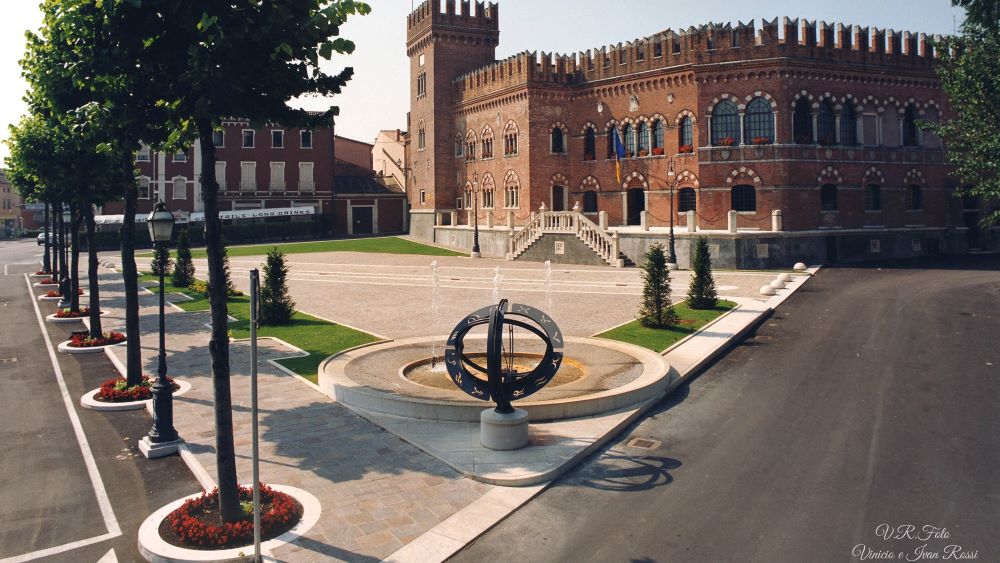
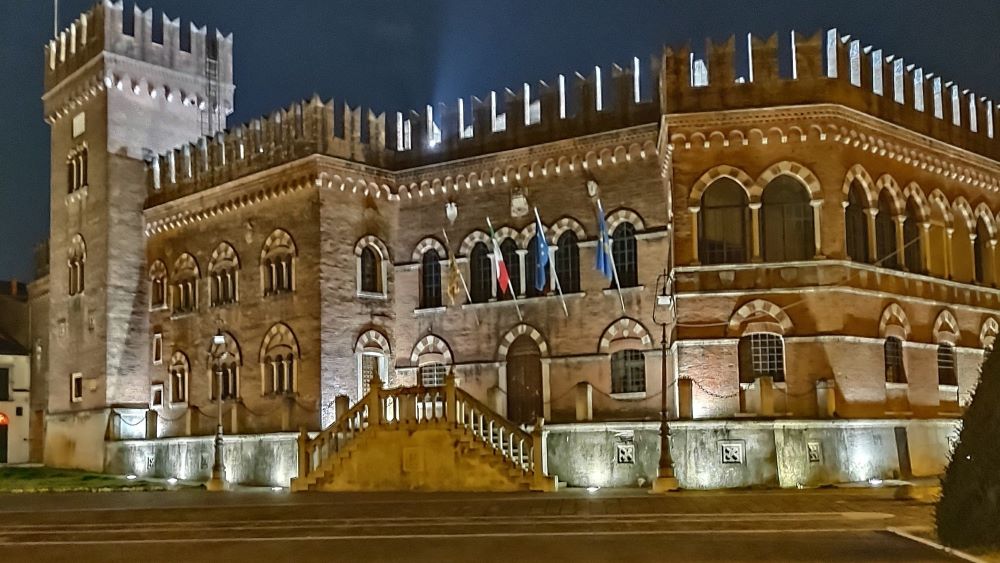
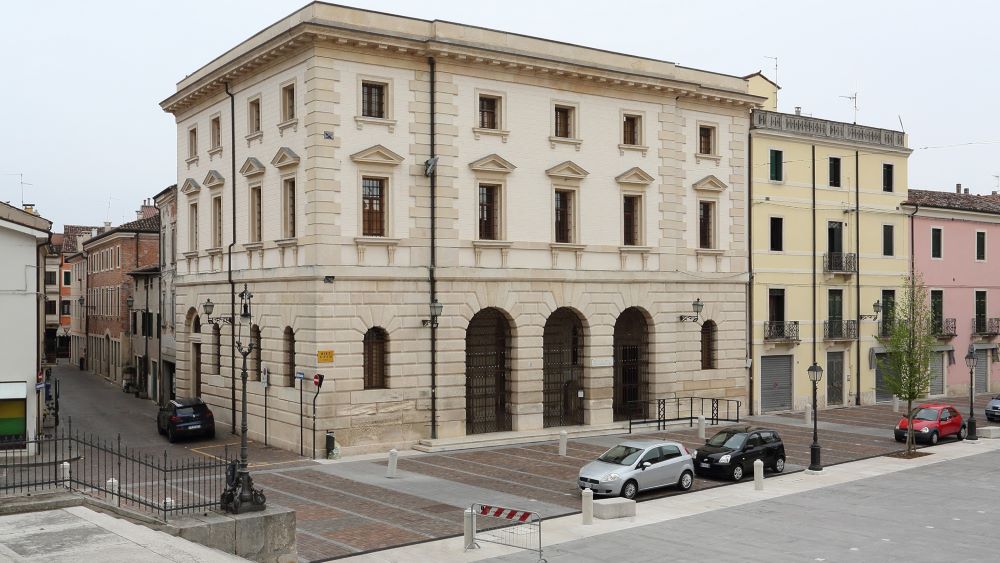
The historic centre of Cologna Veneta is built on the site of an ancient fortress. Starting from Piazza Corte Palazzo (lit. Palace Court Square), you can admire Palazzo del Capitaniato (lit. Captain’s Palace), also known as Palazzo Pretorio (lit. Praetorian Palace). This ancient building was once the residence of the Praetors and Governors of Cologna. During the Venetian domination (1405–1797), it became the official residence of the Podestà Capitano. In the 20th century, it was restored and converted into the town hall. The square in front of it was also rebuilt on the site of the ancient Flumen Novum, which is now called Guà River.
Continuing along Via Marco Minghetti, you will reach Piazza Mazzini (lit. Mazzini Square), home to the Civic Tower, a brick building dating back to 1555 : originally, it was one of twelve towers, each of which divided into two wooden floors, that were part of the walls surrounding Cologna. The current clock has been functioning since 1914, while the original bell, originally brought from the Serenissima, was replaced — following damage — by a large bell known as San Simon, which dates from 1714.
Crossing the Tower, you will arrive at Piazza del Mandamento (lit. Mandamento Square; a mandamento was an administrative district under the jurisdiction of a ‘praetor’). Here, the Flumen Novum, now called Guà River, used to flow until 1901, when it was diverted due to a disastrous flood. Here, you will also find the Municipal Theatre, formerly known as Teatro Sociale (lit. Social Theatre), which was built between 1856 and 1875. This building has a rectangular layout, with external walls made of Berici limestone and reinforced by buttresses of the same material.
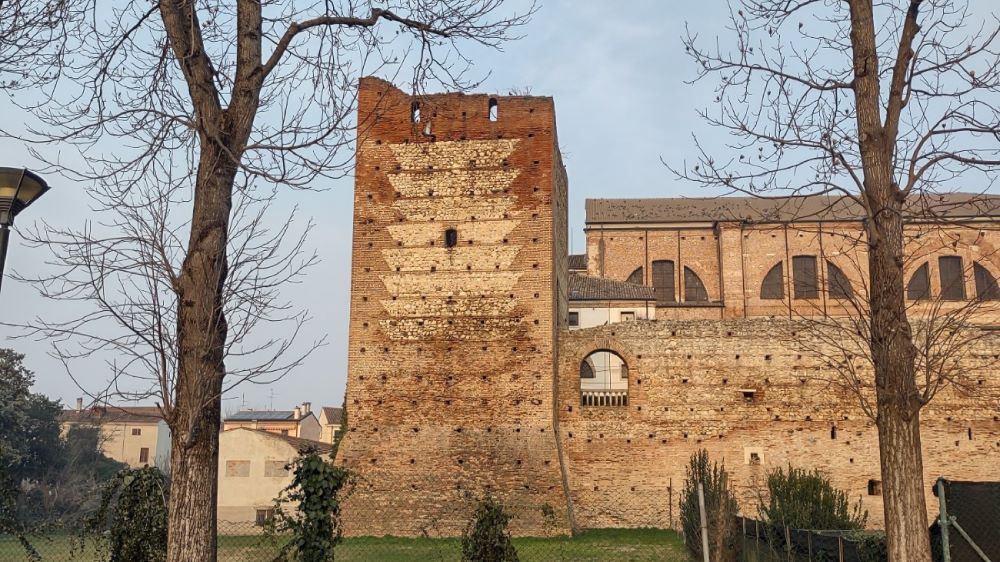
Turn right onto Via Papesso, where you will find the Chiesa delle Cappuccine. Opposite is the Porta delle Cappuccine (lit. Capuchin Clares’ Gate), formerly known as Porta Nuova (lit. New Gate), which was one of the two original entrances to the fortress. On the right, you will see the remains of the 11th-century Castello Scaligero (lit. Scaliger Castle), which was destroyed around 1200. Of the eight towers that made up the fortress, only one remains today. In its masonry, you can see several layers of pebbles forming a staircase — a distinctive feature of the buildings erected by the Scaligeri family.
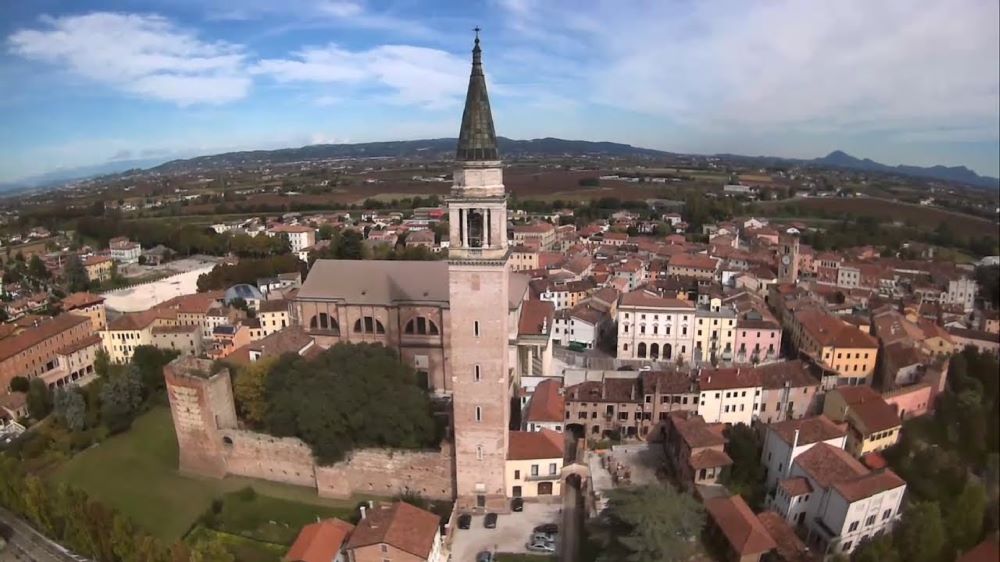
Pass through Porta delle Cappuccine to arrive at Piazza Duomo (lit. Duomo’s Square), home to the Cathedral of Cologna Veneta. Its construction began in 1803 and was completed in 1821. Dedicated to the Nativity of the Virgin Mary, the Cathedral is an example of the Neoclassical style. Its façade is composed of ten eight-metre-high columns and is embellished with a 25-step staircase made of Sant’Ambrogio marble. The bell tower, one of the tallest in the Veneto region, was built on the site of one of the original towers and provides access to the Lapidary Museum. Inside, you can admire the remains of an aqueduct, bricks, millstones, a Roman funerary stone, and four Gothic capitals from the old cathedral, as well as other artefacts from the Renaissance period.
Adjacent to the cathedral is the Archaeological Museum, which houses artefacts from the ancient inhabitants of Cologna Veneta. Located in the Santo Monte di Pietà building (the former pawnshop), it is the oldest archaeological museum in the province of Verona. It was established in 1896 thanks to the efforts of Baldaria’s Archpriest Bortolo Fochesato, who assembled a collection of archaeological finds.
Finally, moving away from the historic centre, to the right of the Cathedral you will reach Ponte Catullo (lit. Catullo Bridge), formerly known as Porta Veronese (lit. Veronese Gate), which functioned as the second entrance to the old fortress.
Places of Interest
To display all the landmarks in the Municipality of Cologna Veneta, go to the dedicated page and filter the results according to your needs.