![[citta murate veneto] Logo Trasp](https://cittamurateveneto.it/wp-content/uploads/elementor/thumbs/citta-murate-veneto-Logo-Trasp-q81hfxb660cjerdzpkmz2g2efhtngv5ypmrebvdwvk.png "[citta murate veneto] Logo Trasp")
![[citta murate veneto] Logo Trasp](https://cittamurateveneto.it/wp-content/uploads/2023/06/citta-murate-veneto-Logo-Trasp-300x300.png)

Verona
Municipality
Piazza Bra, 1
Verona (VR) – 37100
Luogo di timbratura del Lasciapassare incluso nel kit “Viaggio nel tempo”:
Historical overview
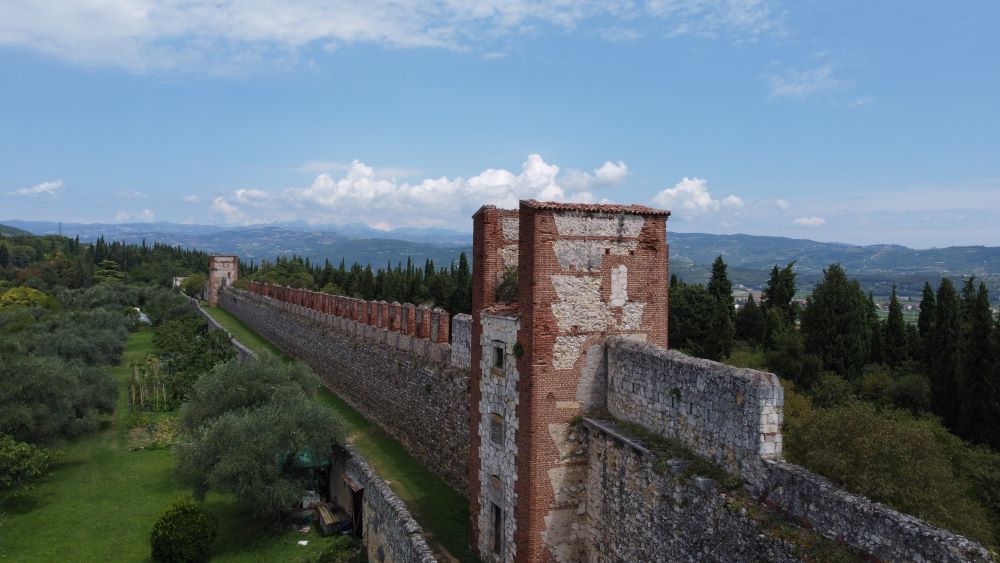
Verona, founded in the 1st century BC, is crossed by the waters of the Adige River and surrounded by hills that enhance its beauty and its harmonious landscape. Favoured by its geographical location, Verona was an important urban centre in Roman times, of which sumptuous traces remain today, from the Arena to the Roman Theatre, from the Arco dei Gavi (the Gavi’s Arch) to Porta Borsari (Borsari Gate), and to the archaeological area of Porta Leoni (lit. Lion Gate). Between 489 and 526, King Theodoric extended the defences from the Colle di San Pietro (St. Peter’s Hill) to the Adige River. The city walls, built in the 12th century along the Adigetto River, were doubled in size by Ezzelino III da Romano (1240-1250). Between 1287 and 1289, Alberto I della Scala erected a new section of city walls on the left bank of the Adige River, much further south than the previous municipal walls. In 1321-25, Cangrande I della Scala had new walls built on both banks, while Cangrande II was responsible for the construction of the Castello di San Martino in Aquaro (lit. Castle of St. Martin in Aquaro) in 1354, later called Castelvecchio (lit. Old Castle). After the city passed into the hands of the Milanese dominion, between 1390 and 1395 Gian Galeazzo Visconti built Castel San Pietro (lit. Castle of St. Peter). Under the Venetian Republic, between 1517 and 1525, the walls were reinforced with round towers called rondelle (by the will of Teodoro Trivulzio), while between 1530 and 1551, the walls were reinforced with bastions and gates by Michele Sanmicheli and Francesco Maria della Rovere. Between 1801 and 1802, by order of Napoleon, the main walls on the right bank of the Adige River were demolished. Under Habsburg rule, between 1833 and 1845, at the behest of General Radetzky, military architects led by Franz von Scholl reinforced and rebuilt the city walls, integrating them with external fortifications, making Verona the main stronghold of the Habsburg Quadrilateral from 1848 onwards.
City itinerary
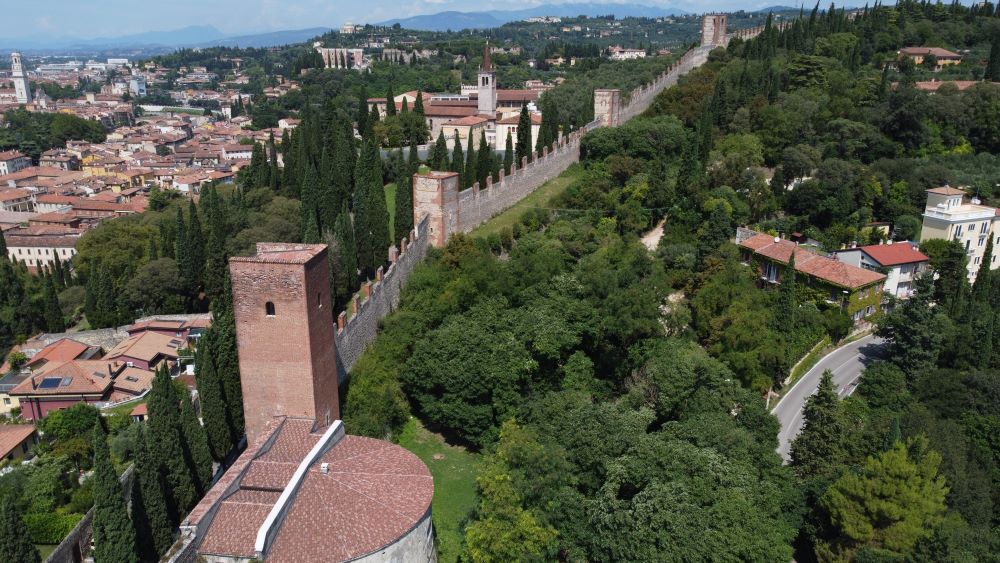
The imposing city walls stretch for over nine kilometres along the perimeter of the historic centre, splitting into two parts: one on the right and one on the left of the Adige River, both integrated with fortifications built over seven centuries. While the remains of Roman fortifications dating back to the city’s foundation are still preserved within the urban centre, the two parts on opposite banks of the river have distinct architectural, technical and environmental characteristics. Noteworthy are the pre-Scaliger walls and the urban castles: the famous Castelvecchio and Castel San Pietro (also called Castel Nuovo – lit. New Castle). Unique in Europe in terms of size and variety, the itinerary along the walls covers two thousand years of military architecture, that is why the municipality established the U.V.A.M., an Italian acronym standing for the Ufficio Valorizzazione Architettura Militare (lit. the Office for the Promotion of Military Architecture).
The right portion of the walls begins at the Romanesque Chiesa di S. Zeno Maggiore (the Church of St. Zeno). Following Via Tommaso Da Vico, you reach Porta Fura (lit. Fura Gate), which forms part of the municipal walls; in the middle of the river are the remains of the Torre della Catena Superiore (lit. Upper Chain Tower). After the Bastione di Spagna (lit. the Spanish Bastion), which dates back to 1548, you reach the Bastione di S. Procolo (lit. the Bastion of St. Procolo) and five other similar bastions, designed during the Habsburg era by Franz von Scholl on Venetian bastions. Continuing on, you will encounter, in succession: Porta S. Zeno (lit. St. Zeno Gate, 1540), Bastione di S. Zenone (lit. Bastion of St. Zenone), Cavaliere di San Giuseppe (lit. Fortification of St. Joseph, 1538-40), Bastione di S. Bernardino (lit. Bastion of St. Bernardine), Porta Palio (lit. Palio Gate), Bastione di S. Spirito (lit. Bastion of the Holy Spirit), Bastione dei Riformati (lit. Bastion of the Reformed Fathers) — which is open to visitors —, Porta Nuova (lit. New Gate, — which has been altered in 1854 —, Bastione della Trinità (lit. Bastion of the Holy Trinity), and Bastione di S. Francesco (lit. Bastion of St. Francis).
The left portion of the walls follows the outer road from Porta San Giorgio (lit. St. George Gate) to the archway of Castel San Pietro, and then continues up to Porta Vescovo (lit. Bishop Gate), returning finally to the outside at Porta Vittoria Nuova (lit. New Victory Gate). Of particular note in terms of landscape is the walled enclosure built by Cangrande I (1321-25), which begins at the archway behind the Chiesa di San Giorgio in Braida (lit. the Church of St. George in Braida), in Via Breccia San Giorgio, and climbs the hillsides to enclose the Colle di San Pietro and the Valle di San Giovanni (lit. St. John Valley). It then connects to the south with the Scaliger walls built by Alberto I (1287-89), reinforced by bastions and integrated with earthen ramparts in the 16th century.
The itinerary begins at Porta San Giorgio, where you can see the Chiesa di S. Giorgio in Braida on your right. Continue outside, passing the Rondella delle Boccare and the Venetian Rondella della Bacola, beyond which you continue inside the walls, reaching the remains of Castel San Pietro: from its gardens you can enjoy a beautiful view of the city. Returning along the walls, climb the hill, leaving Castel San Felice (lit. Castle of St. Felix) on your left, and descend, encountering frequent Scaliger towers in the section between the outer Rondelle of Grotta and S. Zeno in Monte. Shortly after the small Chiesa di San Zeno in Monte (lit. Church of St. Zeno in Monte), you reach the archway of the Austrian casemate, visible as you exit the walls; from here, a detour leads to the Austrian counter-scarp battery. Returning inside the walls, leave the Bastione di Santa Toscana (lit. Bastion of St. Toscana) on your left. From Porta Vescovo, the route continues outside, skirting the Bastione delle Maddalene (lit. Bastion of the Maddalene), Porta di Campofiore (lit. Campofiore Gate) and the Bastione di Campo Marzio (lit. Bastion of Campo Marzio), dating back to 1560. Finally, near the gateway of Porta Vittoria Nuova, you will find the spur of the lower Catena, built by Antonio della Scala.
Places of Interest
Per visualizzare tutti i luoghi di interesse del Comune di Verona accedi alla pagina dedicata e filtra i risultati secondo le tue esigenze.