![[citta murate veneto] Logo Trasp](https://cittamurateveneto.it/wp-content/uploads/elementor/thumbs/citta-murate-veneto-Logo-Trasp-q81hfxb660cjerdzpkmz2g2efhtngv5ypmrebvdwvk.png "[citta murate veneto] Logo Trasp")
![[citta murate veneto] Logo Trasp](https://cittamurateveneto.it/wp-content/uploads/2023/06/citta-murate-veneto-Logo-Trasp-300x300.png)

Cittadella
Municipality
Palazzo Mantegna Via Indipendenza, 41
Cittadella (PD) – 35013
Where to stamp the ‘Lasciapassare’ included in your ‘Traveller’s Kit’.



Historical overview
Located between the ancient Postumia road and the road leading down from the Valsugana, Cittadella has been a key centre since ancient times. The city was founded in 1220 when the municipality of Padua decided to build a fortified settlement to protect itself from the threat posed by Treviso and Vicenza. From that moment on, it became the centre of a community governed under its own statutes.
Cittadella suffered Ezzelino III da Romano’s terrible domination between 1237 and 1256. During the 14th and 15th centuries, the town was once again under the control of the Carraresi of Padua and became the capital of the Paduan territory. In 1406, the town, like the entire Veneto hinterland, came under Venetian control. The Serenissima Republic controlled these lands until 1797, when Napoleon conquered northern Italy during the Italian Campaign. After the Treaty of Vienna in 1815, the Veneto region passed under Austrian control until becoming part of the Kingdom of Italy in 1866.
City itinerary
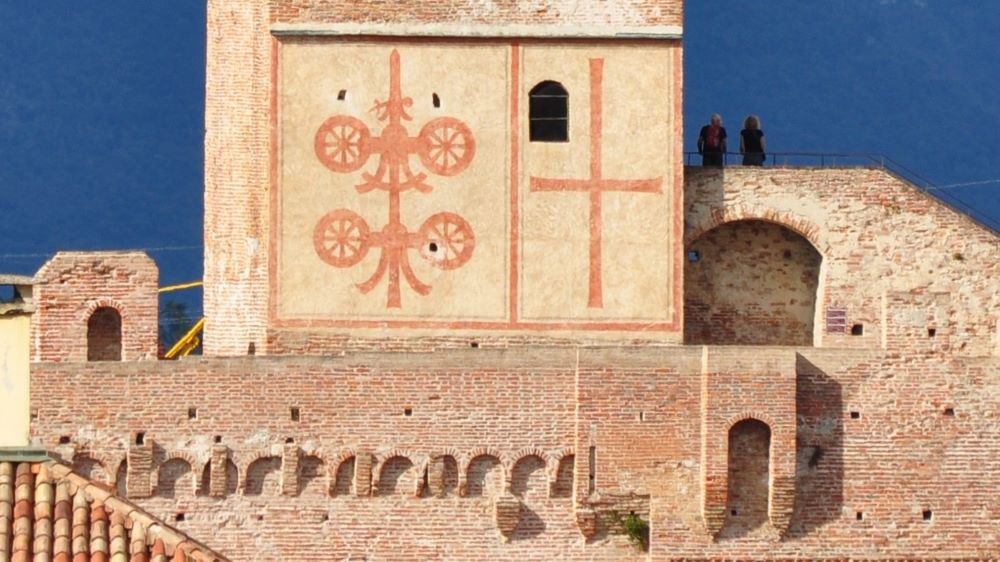
Of the many possible ways to explore our city, we recommend starting with the wonderful experience of walking on its walls, as Cittadella is the only walled city in Europe to have a medieval wall walk that is elliptical in shape and completely strollable.
After parking in Piazzale del Milite Ignoto (lit. Square of the Unknown Soldier), next to Villa Rina, head along Riva del Grappa towards Porta Bassano (Bassano Gate). As soon as you enter this city gate, you will find the Tourist Information Office, from where you can directly access Cittadella’s walls.
Start your journey by exploring the frescoed hall of the Casa del Capitano (lit. the Captain’s House) and the Medieval and Renaissance Museum. Then, venture onto the 12-metre-high wall walk, a real ‘open-air museum’ offering stunning views.
Halfway along the route, you will pass through the Tower of Malta at Porta Padova (Padua Gate). This was once a terrible prison built by Ezzelino III da Romano, but is now an archaeological museum with a 30-metre-high panoramic terrace. Continue towards Porta Bassano, your starting point, and admire the beauty of the historic centre with its four main streets. On clear days, you can even see the Euganean Hills to the south and Mount Grappa with the Alpine arc to the north.
Next, enter the city walls and continue along Via Roma towards Piazza Luigi Pierobon, the main square, which is dominated by the cathedral and the Palazzo della Loggia (the Loggia Palace), a Gothic building with a portico on its ground floor.
Turn right onto Via Indipendenza and you will find the elegant Neoclassical Teatro Sociale (lit. Social Theatre) on your left. Further along is Palazzo Mantegna (Mantegna Palace), the town hall, behind which is the open-air Campo della Marta theatre, where events are held during the summer season.
From Porta Vicenza (Vicenza Gate), you can access the public gardens, while a pleasant walk along the foot of the walls will lead you to Porta Padova, which was once equipped with a drawbridge. Returning to the city centre, the Tower of Malta is on your right whereas the façade of the 18th-century Church of Torresino, built by Padua adjacent to the city walls, is on your left.
Walk under the porticoes along Via Garibaldi, leaving Porta Padova behind you, to return to Piazza Luigi Pierobon. Turn right into Via Marconi to reach the 15th-century Palazzo Pretorio (lit. the Praetorian Palace), formerly known as Monte di Pietà (the Pawnshop), which belonged to the Lords of Cittadella, Roberto Sanseverino and Pandolfo Malatesta.
Finally, leaving Porta Treviso (Treviso Gate), you will return to the car park in Piazzale del Milite Ignoto (Villa Rina).
Places of Interest
To display all the landmarks in the Municipality of Cittadella, go to the dedicated page and filter the results according to your needs.