![[citta murate veneto] Logo Trasp](https://cittamurateveneto.it/wp-content/uploads/elementor/thumbs/citta-murate-veneto-Logo-Trasp-q81hfxb660cjerdzpkmz2g2efhtngv5ypmrebvdwvk.png "[citta murate veneto] Logo Trasp")
![[citta murate veneto] Logo Trasp](https://cittamurateveneto.it/wp-content/uploads/2023/06/citta-murate-veneto-Logo-Trasp-300x300.png)

Portobuffolè
Municipality
Piazza Maggiore, 1
Portobuffolè (TV) – 31040
Where to stamp the ‘Lasciapassare’ included in your ‘Traveller’s Kit’.


Historical overview
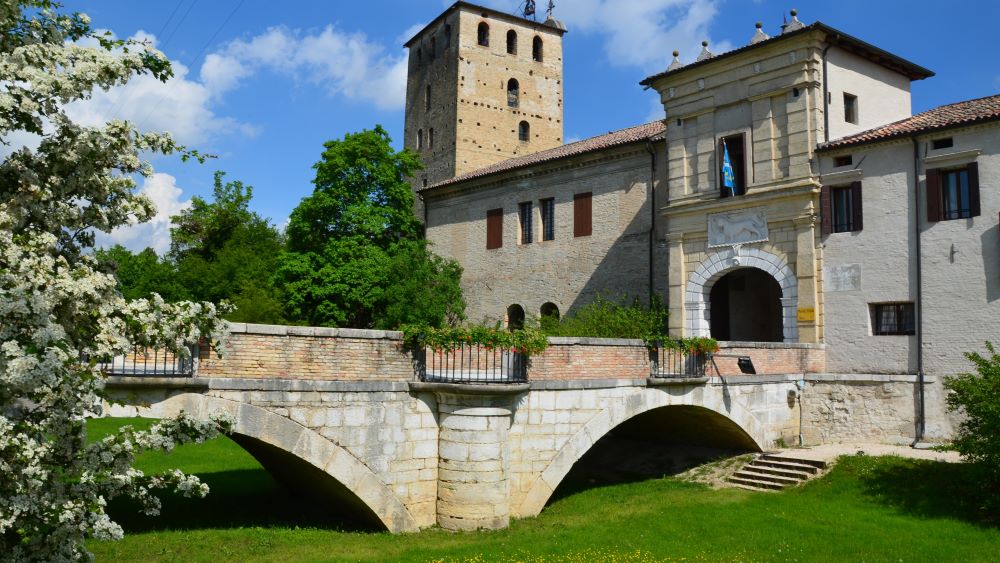
After the Roman conquest in 201 BC, the area in which Portobuffolè is located was named Septimum de Liquentia and developed into a significant river port. A fortified castle was built even before the year 1000, initially belonging to the Diocesi di Ceneda (lit. the Diocese of Ceneda) and later to the Podesteria of Treviso (lit. the Podestà’s territory of Treviso). During the 12th century, the name Septimum was replaced by Portus Bufaledi, as ‘bova’ in Medieval Latin means ‘canal’, from which the current name derives. In 1293, Tolberto da Camino and his wife, Gaia, made Portobuffolè their official residence and were proclaimed lords of the city in 1307. The fortified city was surrounded by a canal created by diverting the Livenza River, as well as by imposing walls interspersed with seven towers. Only one of these towers has survived to the present day: it has remained well preserved over time due to its main use as a prison until the beginning of the 19th century. From 1339 to 1797, the city enjoyed a long period of prosperity under the rule of the Venetian Republic.
City itinerary
As you enter the historic centre through Porta Trevisana (lit. Treviso Gate), you will immediately come upon the small, elegant Piazza Beccaro (lit. Beccaro Square). This square is surrounded by buildings with impressive façades, some of which are decorated with frescoes. From here, you can reach the splendid 14th-century residence of Gaia da Camino, a cultured and charming noblewoman who was celebrated by Dante in the sixteenth chant of Purgatory. Inside the palace, you can admire 14th-century frescoes depicting scenes of life from the late Middle Ages. In the charming historic centre, alongside the house-museum of Gaia da Camino, you can also admire the Dogana (the Customs), the Monte di Pietà (the Pawnshop), the Loggia Comunale (the Townhall Loggia) — a reconstruction of a Gothic warehouse —, and the Duomo, which was originally a Jewish synagogue. Inside the Duomo, there is a 15th-century wooden crucifix from the German school and a splendid organ by Callido of Venice with 472 zinc and tin pipes. The Torre Civica (lit. the Civic Tower) houses the Museo della Civiltà contadina (lit. the Museum of Rural Life), which was created to pay homage to the culture and traditions of the Upper Livenza area. It illustrates the origins and development of the arts and crafts practised by the surrounding communities from the late 19th to the mid-20th century. The Chiesa di San Prosdocimo (lit. the Church of St. Prosdocimus), also known as the Basilica di Santa Maria dei Servi (lit. the Cathedral of St. Mary of the Servants), stands in Via Borgo Servi. Near this church, you can visit the Museo del Ciclismo (lit. the Cycling Museum), which is dedicated to Duilio Chiaradia — Rai’s greatest cameraman and the inventor of sports television broadcasting — and Giovanni Michieletto, the winner of the fourth Giro d’Italia. Housing valuable and prestigious memorabilia, the museum is one of the most important Italian museums dedicated to cycling. On the second Sunday of every month, you can visit the permanent exhibition ‘Atelier della Barbie’ in Via Contratti. Set up by Genoese author Grazia Collura, it uses Barbie dolls to showcase fashions, trends and past eras in hundreds of variations. The exhibition is a testament to the skill of the craftsman, who is able to transport us through a timeline stretching from the past to the present. Afterwards, we recommend going to Via Roma to see the precious Oratorio di Santa Teresa (lit. the Oratory of St. Teresa), a building of high artistic and symbolic value, and the Chiesa di San Rocco (lit. the Church of St. Rocco), which was built in 1530 and is dedicated to St. Rocco, who is invoked as the protector against the plague and numerous infectious diseases. The church provided, in fact, religious comfort for inhabitants, travellers and boatmen who were forced to quarantine in the nearby hospital. Inside, there are numerous statues of saints to whom the people were devoted, including a valuable 16th-century wooden sculpture dedicated to the Madonna and Child.
Places of Interest
To display all the landmarks in the Municipality of Portobuffolè, go to the dedicated page and filter the results according to your needs.